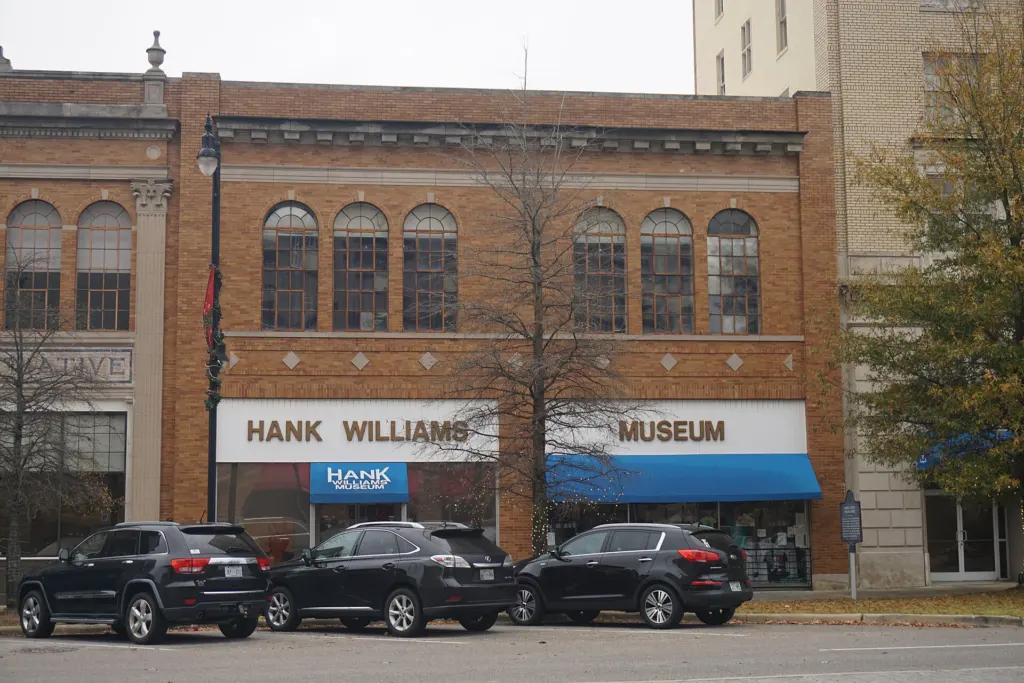
The Hank Williams Museum is at 118 Commerce Street in downtown Montgomery, Alabama. It opened on February 8, 1999, and its centerpiece is the singer’s 1952 baby-blue Cadillac, per the Encyclopedia of Alabama.
Montgomery’s three Hank Williams stops
The city’s tribute to Williams runs through a museum, a statue and a grave site, all within a short drive of each other.
| Stop | Where | What to know |
|---|---|---|
| Hank Williams Museum | 118 Commerce Street | Opened 1999; about 6,000 square feet; the 1952 Cadillac, stage suits and personal items |
| Bronze statue | About one block north of the museum | Museum founder Cecil Jackson helped erect it |
| Grave site | Oakwood Cemetery Annex | Matching marble monuments for Hank and Audrey Williams; free to visit during normal daily hours |
Source: Encyclopedia of Alabama, “Hank Williams Museum” (last updated September 2025) for the museum and statue, and Explore Southern History for the grave site.
Who Hank Williams was
Hank Williams was born on September 17, 1923, in Mount Olive, Alabama, according to Wikipedia. He made his Grand Ole Opry debut on June 11, 1949, receiving six encores, and was dismissed from the Opry on August 11, 1952. He died on January 1, 1953, aged 29, in the back seat of a car on the way to a New Year’s Day concert in Canton, Ohio.
A 2006 Associated Press report carried by NBC News notes that his hits included a dozen singles at No. 1, among them “Your Cheatin’ Heart,” “I’m So Lonesome I Could Cry,” “Cold, Cold Heart” and “Jambalaya (On the Bayou).” The museum’s own site describes Montgomery as his hometown, where he spent most of his life, which is why the city holds the museum, the statue and his grave.
Inside the museum
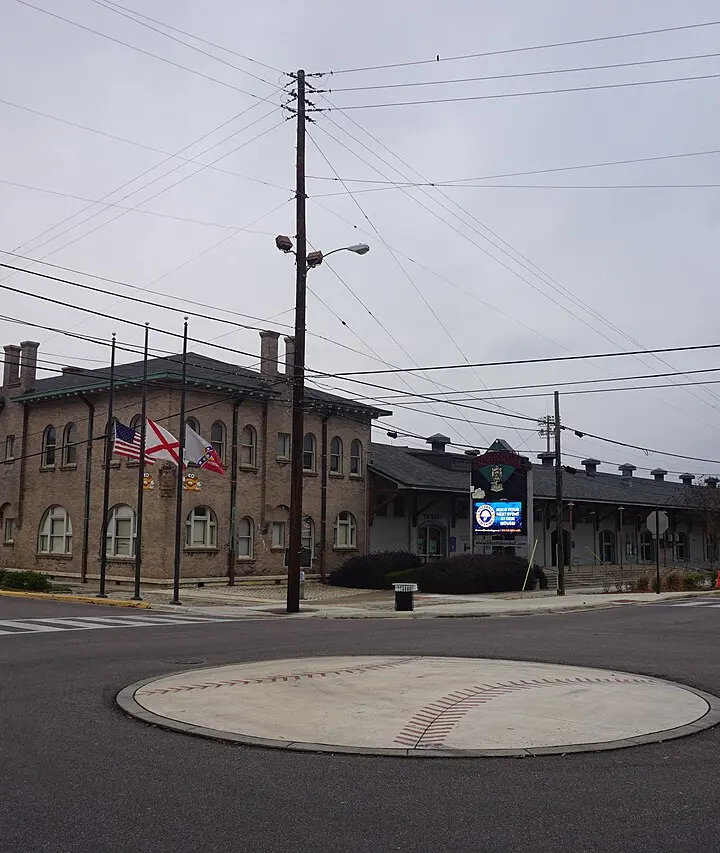
The Encyclopedia of Alabama says the museum opened its doors on February 8, 1999, in Montgomery’s Union Station building, then moved a few years later to a 6,000-square-foot space on Commerce Street. It was founded by Cecil Franklin Jackson (1936-2010), a lifelong fan who first met Williams in 1944, when Jackson was eight years old, at a service station near his childhood home in the Lightwood community of Elmore County.
The 1952 Cadillac
The car Williams died in is the museum’s best-known exhibit. The encyclopedia says he bought it used on July 17, 1952; its original sticker price was $5,083.95, and it came with twin 4-barrel carburetors, a signal-seeking radio and power steering. His son, Hank Williams Jr., drove it for several years, including to high school. It was restored in 1985 and is on loan to the museum from Williams Jr.
Clothing, instruments and personal items
- Display cases. More than 30 cases hold personal artifacts, including 17 suits, boots, hats, ties, awards, furniture and a horse saddle.
- Portraits. Three life-size portraits of Williams came from the home he shared with his first wife, Audrey.
- Instruments and stage gear. His Steinway piano, a 1937 Gibson guitar, a fiddle, and the microphone and stand he used at his last performance.
- Everyday objects. A pearl-handled pistol, slippers, a shaving kit, a camera, his high-school yearbook, his birth certificate and a pair of blue suede shoes.
Dozens of his records, along with his own vinyl collection, line the walls.
Visiting the museum
The museum’s official site gives the address as 118 Commerce Street, Montgomery, AL 36104, and says no photos, videos or cell phones are allowed during the tour. There is an entrance fee, and the encyclopedia notes a discount for children. Prices and opening hours change, so check the museum’s site or call 334-262-3600 before going.
The encyclopedia lists a gift shop selling books, clothing, posters and music, a “Friend of the Legend” fundraising program, songwriting workshops, concerts for local musicians and an annual birthday celebration around September 17. It also names nearby attractions: the Historic Train Shed and Union Station, the Equal Justice Initiative’s Legacy Museum, the Riverwalk and Riverwalk Stadium, and the Montgomery Performing Arts Centre.
The funeral and the statue
Williams’s funeral was held on January 4, 1953, at the Montgomery Auditorium. Wikipedia puts about 2,750 people inside and an estimated 15,000 to 25,000 outside, and the NBC News report says the service was broadcast to the crowds outside.
The bronze statue is the easiest of the three stops to fit into a downtown walk. The encyclopedia says Jackson helped erect the statue that now stands about one block north of the museum. Jackson also led the effort to establish the “Hank Williams Memorial Lost Highway,” a 65-mile stretch of Interstate 65 running from Georgiana in Butler County, the location of Williams’s boyhood home, to Montgomery.
The grave site
Williams is buried at Oakwood Cemetery Annex, about a mile from the museum, per NBC News. Explore Southern History gives the address as 1305 Upper Wetumpka Road and says the cemetery is open to the public during normal daily hours, is free to visit, and has a marble sign reading “Hank Williams Memorial” pointing the way to the grave.
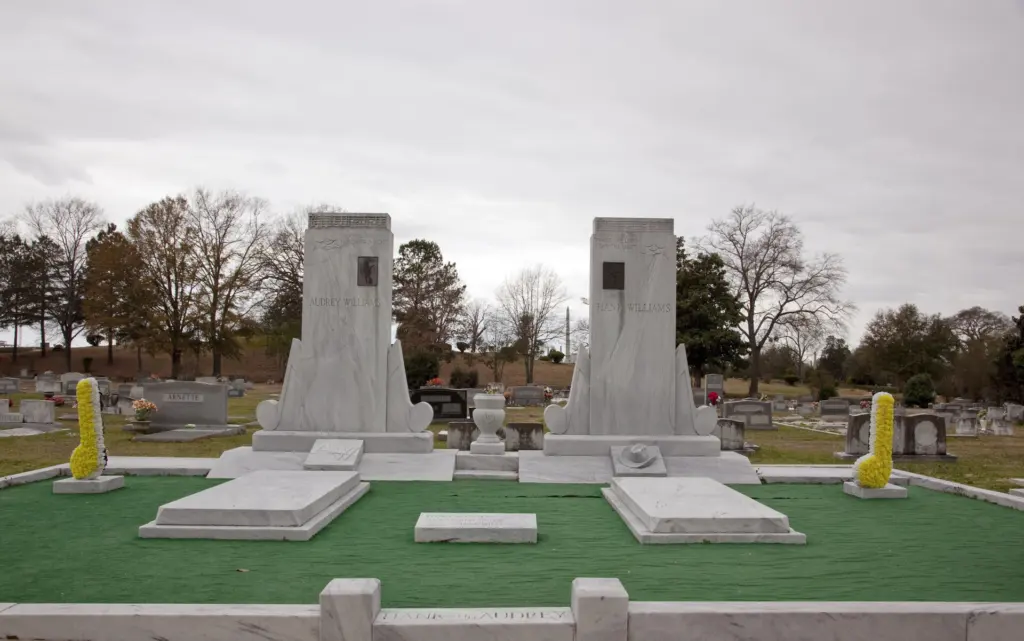
The graves of Hank and Audrey Williams are marked by matching marble monuments. The same source says a representation of his trademark hat is carved in the stone of his monument above the words “Luke the Drifter,” his recording alter ego. NBC News reported in 2006 that ceremonies were held at the cemetery twice a year, on January 1, the anniversary of his death, and on September 17, his birthday.
Fitting it into a Montgomery trip
The museum sits in the downtown core, so it pairs easily with other stops. The guide to things to do in Montgomery gives the wider picture, Montgomery’s civil rights sites are close by, and the Montgomery Museum of Fine Arts suits a quieter afternoon. Lodging is covered in where to stay in downtown Montgomery, and conference travellers can start from the AFITC conference guide. This site is independent and not affiliated with the museum.
Frequently asked questions
Where is the Hank Williams Museum?
At 118 Commerce Street, Montgomery, AL 36104, in downtown Montgomery, according to the museum’s own site.
When did the museum open?
It opened on February 8, 1999, in the Union Station building and later moved to its Commerce Street location.
Is Hank Williams’s car at the museum?
Yes. The museum displays his 1952 baby-blue Cadillac, which is on loan from Hank Williams Jr. and was restored in 1985.
Where is the Hank Williams statue?
The Encyclopedia of Alabama says it stands about one block north of the museum in downtown Montgomery.
Where is Hank Williams buried?
At Oakwood Cemetery Annex in Montgomery, about a mile from the museum. Visiting the grave is free during the cemetery’s normal daily hours, per Explore Southern History.
Can I take photos inside?
The museum’s site says no photos, videos or cell phones are allowed during the tour.
Photo credits: Michael Barera (CC BY-SA 4.0); Carol M. Highsmith, Library of Congress (Public domain).