Old Alabama Town is an outdoor living-history museum in downtown Montgomery, Alabama: a six-block collection of more than 50 restored 19th- and early 20th-century buildings run by the Landmarks Foundation of Montgomery.
What Old Alabama Town is
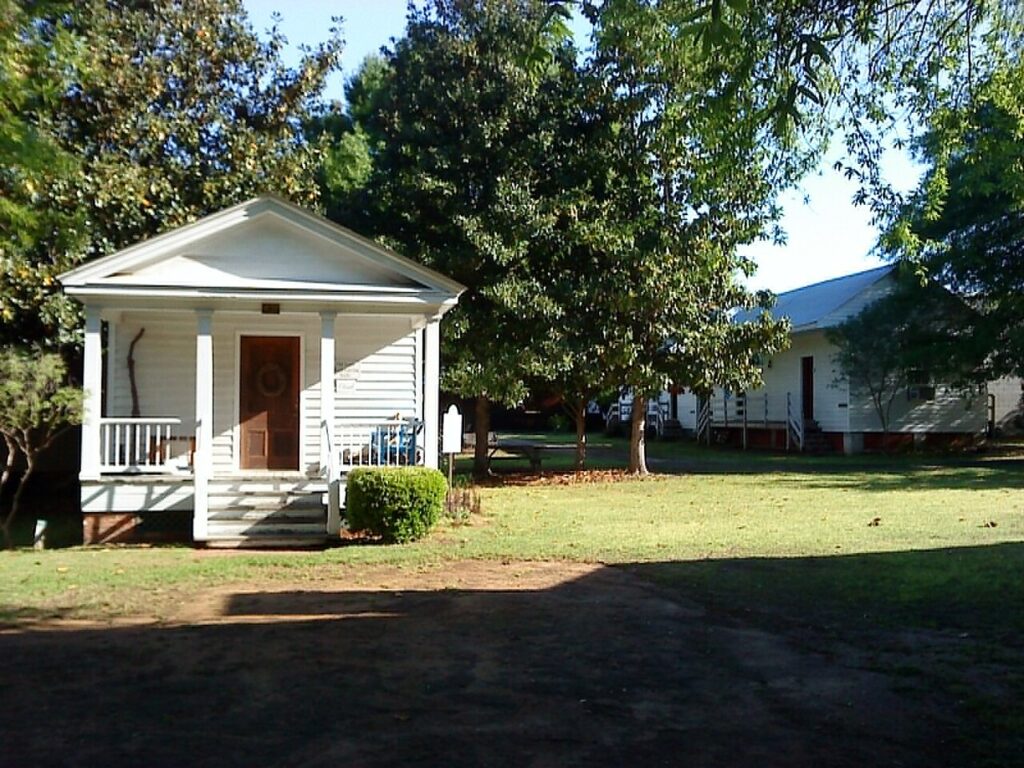
The Encyclopedia of Alabama describes Old Alabama Town as an outdoor museum focused on life in central Alabama during the nineteenth and early twentieth centuries. It sits a few blocks west of the state capitol, stretches along six downtown blocks and holds more than 50 historic buildings. The site offers self-guided tours, group tours and demonstrations, and it doubles as a place where preservationists can house historic structures for protection and restoration.
The village is not a single original settlement: some buildings, such as Lucas’s Tavern and the Thompson Mansion, were relocated here from other places, while others stand on their original sites. This guide is independent and not affiliated with the museum or the foundation.
How it began: the Landmarks Foundation
According to the encyclopedia, the impetus for the site came from efforts to preserve Montgomery’s First White House of the Confederacy, a campaign that sparked the drive toward historical preservation in Montgomery and across Alabama and set a precedent for relocating threatened historic buildings. In 1967 the Montgomery City Commission established the nonprofit Landmarks Foundation of Montgomery to preserve the area’s history and architecture. The museum’s own tour site also dates the start of Landmarks’ restoration work to 1967, while the encyclopedia’s separate entry on the foundation gives 1968 as its charter year.
In 1968 the foundation bought the Ordeman house, an 1850s Italianate townhouse that became the cornerstone of the site. The encyclopedia’s entry on the foundation adds that the restored house and grounds opened to the public in 1971, and that the foundation is instrumental in preserving approximately 60 historic properties around Montgomery. By 1990 it had purchased and restored more than 30 structures, including the 1850 Greek Revival-style Thompson Mansion, which was relocated from Tuskegee.
The areas of the village
The site is organized into themed areas that show how Alabamians worked and lived. The museum’s own tour pages list four tours, matching the areas below.
| Area | What it shows | Buildings named in sources |
|---|---|---|
| Working Block | Nineteenth-century workplaces | Cotton gin, blacksmith’s shop, print shop, grist mill |
| Living Block | Community life | Schoolhouse, doctor’s office, church, carriage house |
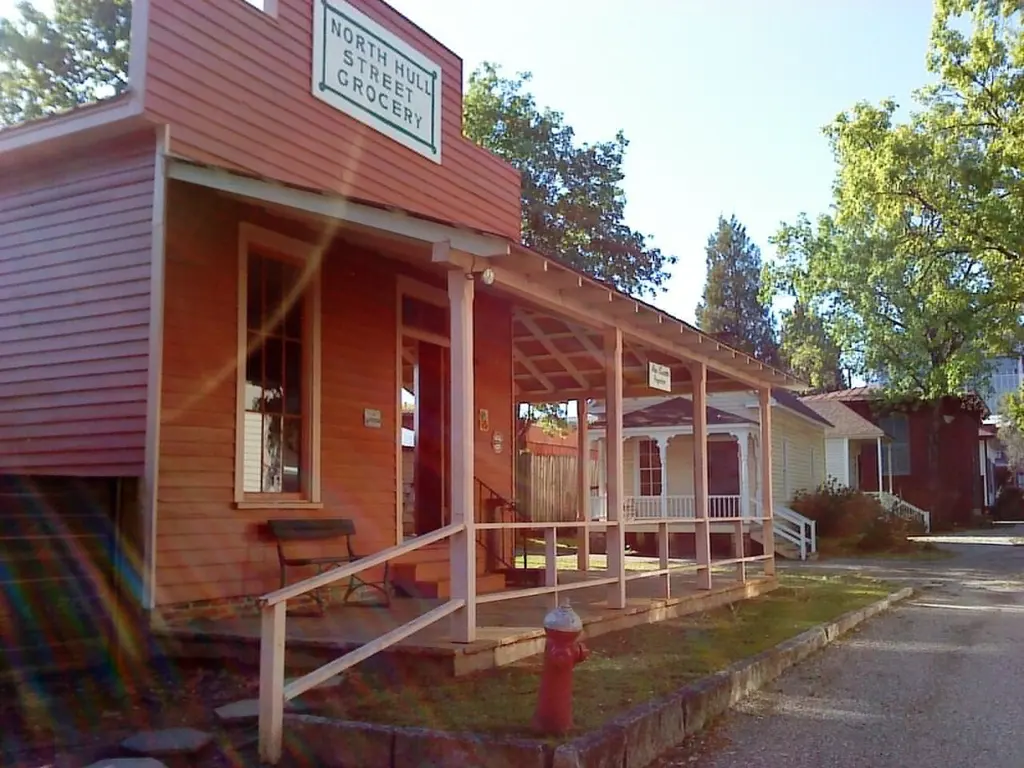
| Along the Street (North Hull Street) | Residential architecture | Bush Cottage, Nall-Young House, Ware-Farley-Hood House |
| Ordeman-Shaw House | An Italianate townhouse on its original site | Ordeman-Shaw House |
Source: Encyclopedia of Alabama, “Old Alabama Town”, and the museum’s tour page.
The Working Block and the Living Block
The Rose-Morris House, dating to the 1840s, marks the entrance to the Working Block, where visitors can tour buildings that recreate nineteenth-century workplaces such as a cotton gin, a blacksmith’s shop, a print shop and a grist mill.
Lucas’s Tavern opens the way to the Living Block. The encyclopedia says the tavern was built at Line Creek, now Waugh, east of Montgomery, in approximately 1818 and was a stopping point on the Federal Road where the Marquis de Lafayette stayed in 1825. Wikipedia adds that the tavern now serves as the visitor and information center, and the museum says tickets are sold at Lucas Tavern, 310 North Hull Street. The Living Block includes a schoolhouse, a doctor’s office, a church and a carriage house.
North Hull Street and the Ordeman-Shaw House
Houses along North Hull Street show the architecture of nineteenth-century Alabama in a range of sizes. Examples include the relatively modest Bush Cottage, from about 1860, the Nall-Young House from the 1850s, and the stately Ware-Farley-Hood House, an Italianate mansion restored with the help of old photographs.
The Ordeman-Shaw House is described on the museum’s site as an Italianate townhouse standing on its original site at 230 North Hull. The encyclopedia says Marvin Schwartz, a curator at the Metropolitan Museum of Art in New York, advised on its furnishings so that the 1850s interior could be authentically recreated.
The foundation’s wider preservation work
Old Alabama Town is only part of what the Landmarks Foundation does. The encyclopedia’s entry says the foundation helped advocate for a city ordinance that created a process to recognize architecturally and historically significant structures, along with an architectural review board. It also led the restoration of Montgomery’s Union Railway Station, built in 1898 and declared a National Historic Landmark in 1976. Other restored buildings include the Greil Mansion, Cody House and Confederate Post Office, now used as offices, and the Teague House, which houses the Alabama Historical Commission. Visitors who want the city’s civil rights history rather than its architecture can start with the civil rights sites in Montgomery.
Beyond the buildings
The Encyclopedia of Alabama’s entry (last updated September 2024) says the site hosts school groups and cultural events, naming bimonthly traditional music jam sessions and the annual Alabama Book Festival, and that it occasionally opens historic homes for public viewing. The entry on the foundation (last updated February 2025) describes an annual house tour series on Montgomery’s architectural heritage and says several buildings are available for event rentals such as weddings and meetings. Event schedules change, so check the museum’s own pages for what is on.
Planning a visit
The museum lists its address as 301 Columbus Street, Montgomery, Alabama 36104. This guide leaves out admission prices and hours because they change and the official pages can differ; confirm both on the museum’s tour site before going.
Old Alabama Town works well as part of a downtown day. The things to do in Montgomery, Alabama guide covers nearby options, the Montgomery Zoo guide suits a longer outing, and where to stay in downtown Montgomery covers lodging close by. Visitors in town for a defense or cyber event can find background in the AFITC conference guide.
Frequently asked questions
Where is Old Alabama Town?
It is in downtown Montgomery, a few blocks west of the state capitol, and stretches along six blocks, per the Encyclopedia of Alabama.
How many buildings does Old Alabama Town have?
The encyclopedia puts the total at more than 50 historic buildings.
Who runs Old Alabama Town?
The Landmarks Foundation of Montgomery, a nonprofit established by the Montgomery City Commission in 1967, runs the museum.
Are the buildings original to the site?
Some are. The Ordeman-Shaw House stands on its original site, while Lucas’s Tavern was moved from Line Creek and the Thompson Mansion was relocated from Tuskegee.
Can I find current hours and ticket prices here?
No. Both change, so use the museum’s tour site.
Photo credits: Drmies (CC BY-SA 3.0); Drmies (CC BY-SA 3.0).